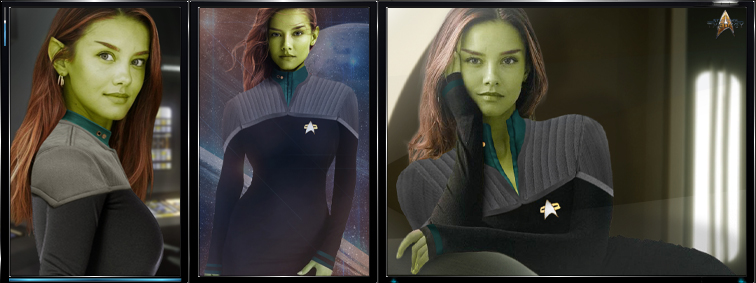
1
Episode 02: Cosmic Imperative / Re: EPI S: The curious case of Humpty Dumpty [Day 03 | 2330 hrs]
Last post by Ellen Fitz -She breathed. In, slow. Out, slower. The elders had taught the kits to do this when their bodies were at war with themselves — when the feral pulled one direction and the Vulpinian pulled another, and nothing agreed. You found the oldest part of yourself, the part that predated the argument, and you held to it.
The sounds of the lab came and went at the edges of her attention — keystrokes, the low consultation of two voices finding a shared technical language, the soft drone of the scanner working its way along her body. She let them be sounds. She went somewhere else.
The day the Freedom Fire came, the eldest kit in the colony had just made her first successful kill in her feral form. They were celebrating. Ehfva remembered the smell of the cook-fire, the sound of the pack in full voice. Then the ship's silhouette crossed the sky. She had known it would come. She had simply chosen not to think about that until the moment it was unavoidable. Her grandmother's paw on the back of her neck. Not comfort. Steadiness.
The crew walked down the ramp as one clan. Her mother in her natural Vulpinian form, ears up, tail moving with ease. An older brother, fully Vulcine, his pointed ears catching the light, his tail hanging loose at his back. Another in their feral form, simply sitting at the base of the ramp, waiting.
On Okashii Atama, you relaxed into your natural Vulpinian form only inside, only among family. The Vulcine form was something else — forbidden, a corruption of the true way, a capitulation to the desire to look like something you were not. She had grown up understanding this as fact, the way she understood that stars were fixed and fire was hot.
The Freedom Fire crew understood this, but they did not share the same beliefs. They were not being provocative. And into this strange world so "at war," with how her grandparents had raised her, Ehfva willingly walked, as it was the expected and right thing to do.
The first months were not something she often described to people because there was nothing useful to say about them. She had been wrong about things she had never thought to question, and that particular kind of wrong left a specific mark. Her siblings — her brothers and sisters from the same parents, the same ship, the same wandering bloodline — had not laughed. They had each gone through their own version of Okashii Atama's unwinding and come out the other side, and they left her room to do the same.
What she remembered most was not the forms but the technology. The humiliation of being unable to operate a panel that a kit of a different upbringing half her age navigated without looking. She had built "tools" from raw materials in her feral form since she was old enough to sharpen a rock. She had never needed anything she could not make. Now she needed everything. She went to the navigation array on the third day because it was the one station that made sense — angles, distances, the relationship of moving things to fixed ones. The elders had taught the kits to find their way home by stars. The technology was the same knowledge in different clothes.
She started there and learned outward, without asking for help unless she had tried and failed twice, and never in front of strangers. The Vulcine form came last, and badly, and in private. In time, she became the one the captain, her father, sent when the negotiation required someone who could read a room in the dark, because her feral form had taught her in ways all the others could not.
When news of Okashii Atama reached the ship, she had been in the navigation bay. She remembered the captain's voice — the specific flatness of it that meant the processing was already done and only the information remained. Survivors. Few. The colony, mostly gone. She finished the calculation she was running. Then she went to find her siblings.
Four had already decided before she arrived. Two more when she walked in. Her parents did not argue.
The Kyodai Obi Military was people with weapons and sufficient motivation, organized just enough to be more dangerous than a mob. She had been trained by elders who believed the most honest form of warfare was the one you won before the other side knew it had started. The feral form at speed in the dark. The natural Vulpinian form for the close work that required hands. The Vulcine form for the infiltration work, when you needed to look like something other than what you were.
The battlefield surprised her. Not the death. The sound of it — her own people in every form, turned entirely toward destroying each other, and she could not always tell which side was which until the fighting started, because they were the same people carrying different grudges.
The name came after the third mission. Ha'tIa. She had not wanted it. Names like that became the story people told instead of looking at you.
She had met him in her male Vulcine form because that was what the negotiation required. He had looked at her face and waited to see what she was going to say. Most people looked at the pointed ears and thought Vulcan, then noticed the tail and reassessed, then found the amber eyes and gave up on the catalog entirely. He skipped all of that.
He had lost his home in a way that rhymed with her loss without being the same loss. They had talked for three hours without agreeing on anything political and with complete agreement on everything that mattered.
Keokuk had already known her male Vulcine form — had known it longer than any other, had done business beside it and shared meals in it and trusted it with things he did not tell other people. What she showed him later was her female Vulcine form, and after that her natural Vulpinian form, and last her feral form, because by then there was nothing left to withhold. She wanted him to understand that the person he had been talking to for months existed in all of these, not one at a time.
He was from a Terran tribe that marked significant things. Many spirits, many selves, all of them real. He said it the way you say something you intend to remember. He had given her a name: Nicoma.
The lab sounds sharpened. The quality of the quiet changed — people finishing rather than working. She looked at the hypo in Leux's hand. She looked at her own hands — wrong, neither one thing nor the other, not anything the elders had a word for. She met Leux's eyes and nodded. When the hypo pressed to her skin she turned her attention inward, reaching for the most familiar pathway first. The natural Vulpinian form — as children, they learned it before any other. The first, the easiest. The one that should have required no thought at all.
It did not come easily. Her mind went down the corridor and found it blocked, turned, doubled back, turned again. She could feel the shape of where the shift should happen, and her concentration kept sliding off it like wet hands on rope. The hypo's compound moved through her, and she tracked it and tried again. Her body throbbed beneath the painkiller — present, insistent, the throb of tissues that could not agree on their own architecture.
The shift, when it came, came slowly. Not the clean unfolding she remembered from sixty years of practice. Something grinding and reluctant, her body arguing with itself about every increment of change. She felt it in her shoulders first, then the restructure moving down through her hands, and she kept her eyes closed because looking would cost her concentration, which she didn't have to spare.
An eternity passed. Possibly three minutes. She looked down. Paws. Her paws — her own familiar timber wolf markings, the fur the right color, the claws the right length. She looked at her feet. Matching. She lifted one hand and felt her muzzle, the elongated line of it, the teeth beneath her lips when she ran her tongue along them. Sharp. Correct. She tensed her shoulders, released. Tensed her haunches, released. Moved down through every muscle group the way the elders had taught, checking each one. Everything answered.
"Stable." Her voice came out rough, the consonants dragged over vocal cords built for a different phonology — growling at the edges, a faint hiss on the sibilants, but intelligible. "Shifted. Full form." She worked her jaw. "Sluggish. More pain than should be, as you said. Nothing past bearing."
She looked at Leux, then Hirek. "Thank you." She said it plainly. "The shift was not normal. I could feel the other forms already — present, waiting. As though they each had a claim on my attention and I was choosing between them rather than simply moving." She considered this. "This does not feel normal. But it feels stable." She did not attempt to stand. She sat on the biobed with her paws flat on her thighs, her tail hanging where it fell, and looked at them both.
"Should I return here in eight hours for the next shift? To do it in a controlled environment, where you can monitor what happens and confirm the implant is functioning correctly across multiple transitions." It was not quite a question — more the reporting of a logical next step, offered for their confirmation or correction.